In the grand tapestry of interactive entertainment, October 2020 stands as a pivotal month — not because of a single game’s release, but because Microsoft began weaving new constellations into its ever-expanding Xbox Game Pass galaxy. At the time, the service was already gaining momentum like a gravitational well pulling in orbiting titles, but the upcoming additions would prove to be the celestial burst that defined its trajectory for years to come. As we look back from 2026, those weeks represent the moment the subscription model truly ignited, fusing legacy classics with cutting-edge blockbusters and planting seeds that would bloom into today’s omnipresent library.
The marquee attraction was undoubtedly DOOM Eternal, the id Software adrenaline injector that had already reshaped the first-person shooter genre. Its arrival on October 1, 2020, for console and Android versions of Game Pass was like a bolt of lightning striking a dormant volcano — explosive, unannounced until shortly beforehand, and utterly magnificent. Players dove into the Slayer’s hell-forged boots, tearing through demons with a ballet of blood and bullets. The PC crowd, however, had to wait slightly longer, with the game promised to hit that platform later in 2020, a staggered rollout that kept anticipation simmering like magma beneath the surface. By 2026, DOOM Eternal has become a permanent fixture in cloud gaming demos, its blistering pace a testament to the engine’s scalability and a reminder of the day Game Pass proved it could host AAA juggernauts on launch day.
Coinciding with that demonic descent was Drake Hollow, a cooperative village-building adventure that dropped on PC Game Pass the very same day. Where DOOM represented raw chaos, Drake Hollow was the gentle hum of community — a title that encouraged players to nurture plant-like creatures called Drakes while defending their makeshift settlements. This juxtaposition resembled a binary star system, where contrasting celestial bodies orbit a common center of gravity: one burning bright with destruction, the other radiating warmth of creation. In the years since, that yin-yang curation philosophy has become Game Pass’s hallmark, balancing massive shooters with indie darlings to craft an ecosystem that attracts every type of player.
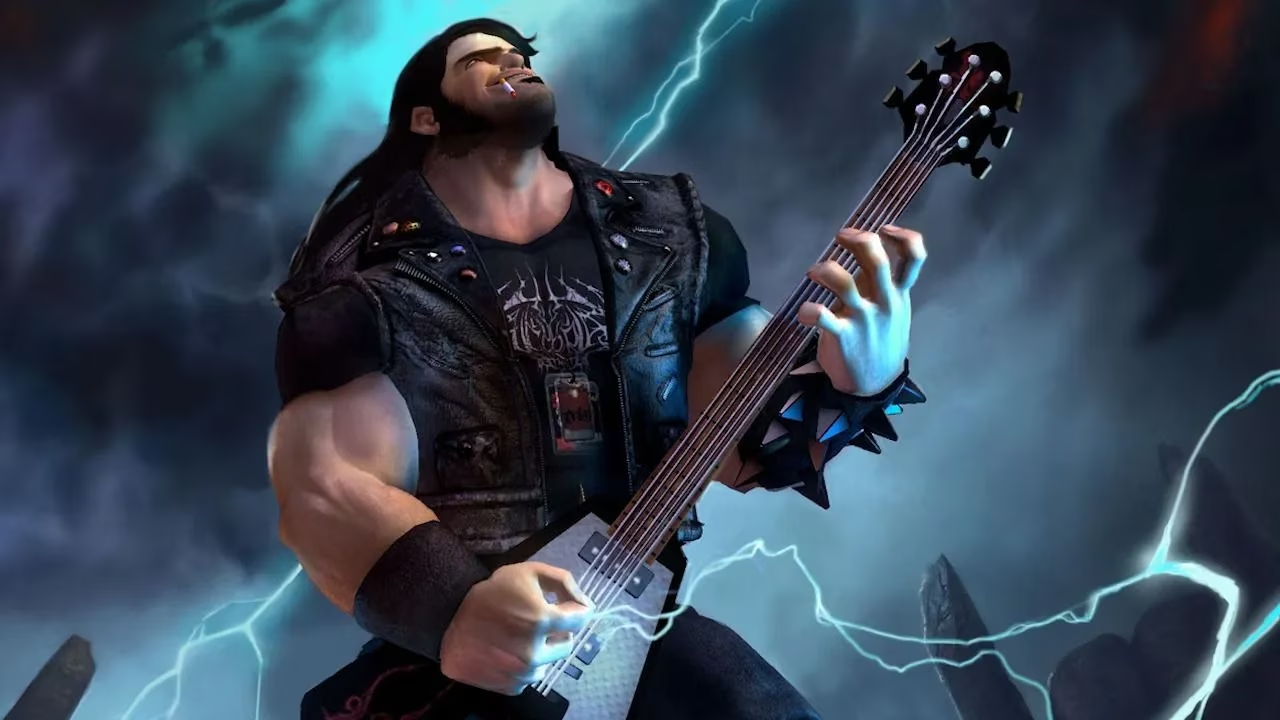
Then came the thunderous second wave. On October 8, 2020, a trio of heavy hitters landed with the force of a meteor shower. Brutal Legend, Double Fine’s heavy-metal opus starring Jack Black, finally roared onto console Game Pass like a long-lost amplifier rediscovered in a dusty garage. Its blend of action-adventure and real-time strategy, wrapped in album-cover aesthetics, had been a cult classic since 2009, and its arrival gave a new generation the chance to wield a battle axe and summon flaming zeppelins. For many, it was a nostalgic pilgrimage; for others, an introduction to Tim Schafer’s mad genius.
Alongside this metal crusade came Forza Motorsport 7, a simulation racing titan that not only joined the console service but also extended its tires to Android and PC. With its laser-scanned circuits and weather systems that could shift from sun-drenched to torrential in a heartbeat, Forza 7 transformed every mobile device into a pocket-sized cockpit — an engineering marvel that presaged the cloud-native racing experiences we now take for granted in 2026. The third title, Ikenfell, arrived on both Xbox and PC Game Pass like a hidden spellbook cracked open. This tactical RPG, with its heartfelt story and timing-based combat, shimmered with the magic of a small studio finding a vast audience through the subscription pipeline. Together, these three games formed a trident of variety: one tine dipped in rock mythology, another in precision engineering, the last in narrative wonder.
But perhaps the most seismic announcement of that October wasn’t a game at all. Microsoft revealed that EA Play would merge with Xbox Game Pass Ultimate on November 10, 2020 — the exact same day the Xbox Series X|S consoles launched. This move felt like an alliance of ancient kingdoms uniting their realms. Suddenly, a vault of FIFA, Mass Effect, Battlefield, and countless other EA classics became part of the Ultimate tier at no extra cost. The timing was surgical: new console buyers hungry for content were handed a banquet. From the vantage point of 2026, that integration was the blueprint for the subsequent partnerships with Ubisoft, Activision Blizzard, and others. What began as a cautious handshake has blossomed into a multi-publisher supernova, with Game Pass now serving as the definitive aggregator of interactive entertainment.
Looking at the cumulative effect, October 2020 appears less like a monthly drop and more like a terraforming event. Each title — from the guns-blazing symphony of DOOM Eternal to the strategic heart of Brutal Legend — added a layer of soil, a breathable atmosphere to the platform’s landscape. The service was no longer an experiment; it was a self-sustaining world. In the ensuing years, we’ve seen the Bethesda catalog flood in after Microsoft’s acquisition, turning Game Pass into a repository of western RPG history. We’ve witnessed day-one launches from third-party studios double in frequency, and we now stream games to devices that didn’t even exist in 2020. Yet the DNA forged in that October remains: a commitment to variety, a respect for legacy titles, and an almost gravitational pull that keeps subscribers locked in orbit.
To understand Game Pass in 2026 is to trace its metamorphosis back to weeks like these. The service has become a living anthology — less a storefront and more a cultural library, where every game is a book waiting to be borrowed. The October 2020 lineup was the moment the library’s lights flickered on, illuminating aisles of heavy metal, racing, village-building, and demon-slaying. And like any good story, its first chapters echo through every page that follows. As we stand here today, with virtual reality games starting to trickle onto the cloud and AI-curated recommendations tailoring our playlists, the heartbeat of 2020’s autumn can still be felt — a primal drum beat that reminds us how a handful of titles can reshape an entire industry’s orbit.
0 Comments