The battle royale genre has never been a stranger to relentless evolution, and Apex Legends continues to prove it isn't afraid to shake up its core mechanics to maintain relevance in an oversaturated free-to-play market. Years after its initial launch, the game surprised players by taking a gamble that became a staple: mobile respawn beacons. What began as a limited-time experiment quickly transformed into a permanent fixture, reshaping how squads approach survival, teamwork, and combat.
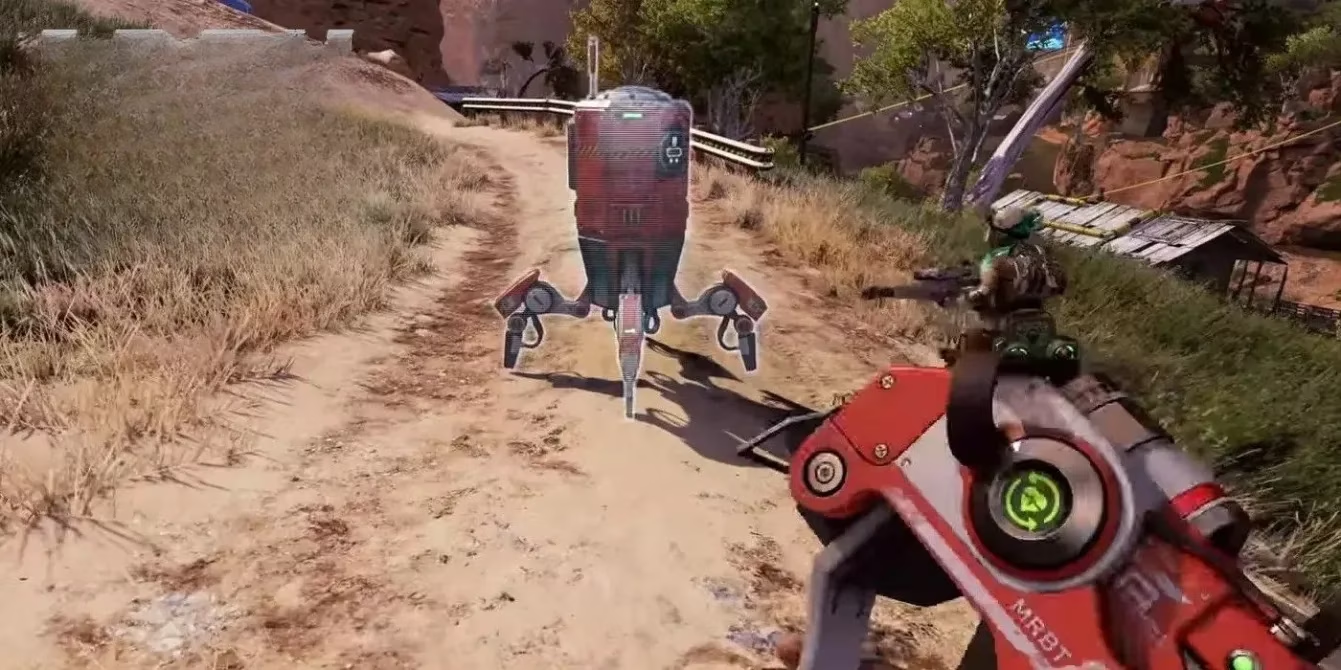
Back in 2020, the Armed and Dangerous Evolved limited-time mode introduced mobile respawn beacons alongside a shotgun-and-sniper-only weapon pool. Every participant started with one in their inventory, granting the ability to call back eliminated teammates from almost any location on the map. No longer were squads forced to risk gunfire at fixed beacon stations; instead, they could orchestrate mid-fight revivals behind cover, inside buildings, or even in the final circle. The mode was a hit, and soon Respawn Entertainment made the decisive move to roll out the item across standard playlists, albeit as lootable gear rather than a guaranteed spawn. Players now had to scavenge for these rare items, adding a layer of strategic depth to inventory management.
Fast-forward to 2026, and the mobile respawn beacon has become as iconic as the Mozambique or the Kraber. Its introduction marked one of the earliest examples of a major battle royale title iterating aggressively on the revival formula. Apex Legends was the pioneer of in-game respawning, an innovation that eventually inspired competitors like Fortnite to adopt similar mechanics. Yet the developers didn't rest on their laurels. Subsequent patches continuously fine-tuned the beacon's drop rate, interaction speed, and even its audio cues to balance its power. At the same time, older revival items like the gold knockdown shield saw adjustments, proving Respawn's commitment to keeping the sandbox dynamic. The studio's willingness to import mode-specific content into the core experience demonstrated a clear philosophy: nothing is off the table if it enhances gameplay variety.
Looking back at the initial player reaction, the discourse was surprisingly split – but not always about the beacon itself. When the official Apex Legends Twitter account confirmed the change, alongside bug fixes for Loba's tactical ability, the replies overflowed with complaints about the then-controversial skill-based matchmaking system. The loudest voices in the community appeared more consumed by kill counts and competitive integrity than by the new resurrection tool. This disconnect highlighted a persistent tension within the player base: the desire for high-octane fragging versus the team-oriented utility of revival items. Over time, however, mobile respawn beacons carved out their own niche. They became clutch saviors in ranked matches, essential toys for streamers chasing high-kill games, and the centerpiece of innumerable highlight-reel saves.
From a tactical standpoint, the mobile respawn beacon completely rewrote endgame logic. A squad wiped but clutching a beacon could rebirth allies on a rooftop or inside a tunnel, turning a 1v3 scenario into a full squad reset in seconds. This led to a shift in meta priorities: securing a mobile respawn became as critical as hoarding shield batteries or arc stars. Professional players in the Apex Legends Global Series adapted rapidly, treating the beacon as a high-value utility that could salvage a near-zero chance of victory. Coinciding updates also introduced crafting stations where beacons could sometimes be fabricated, ensuring teams had multiple avenues to recover even in loot-scarce environments.
Other battle royale titles observed and learned. By 2023, the industry had pivoted toward more forgiving revival systems, whether through redeploy buses, gulag-style duels, or portable respawn vans. Apex Legends' gamble had essentially set a new standard. What was once a bold experiment became a baseline expectation: players want agency over teammate recovery, not punitive runbacks to predictable choke points. Respawn continued iterating with limited-time modes that twisted the concept further, such as “Flashpoint” healing zones and “Always Be Closing” ring mechanics, but the mobile beacon stayed foundational.
In the present day, the mobile respawn beacon's legacy is woven into the fabric of Apex. New legends released since 2020 have abilities that directly interact with resurrection speed, beacon deployment, or spawn protection, creating intricate synergy possibilities. For example, characters like Newcastle can drag downed allies behind his mobile shield and deploy a beacon to complete the revival before enemy squads can push. Item management interfaces now clearly highlight the beacon's rarity tier (typically purple), and experienced players train themselves to instantly identify its distinct glowing silhouette in death boxes. The learning curve for new players now includes not just gun skill and map knowledge, but also the art of the “sneaky beacon” – finding those precious seconds to call down a dropship unnoticed.
Developers at Respawn have spoken publicly about the surprising success of the feature, acknowledging that player feedback was far more positive than initial apprehension suggested. While the community continues to debate matchmaking algorithms, balancing tweaks, and server tick rates, the mobile respawn beacon rarely surfaces as a point of contention. It has earned near-universal acceptance, cementing its place as a permanent part of the Apex Legends identity. As the game marches toward its next evolution, one can only wonder which other experimental features might eventually become tomorrow's standard – but the mobile respawn beacon will always be remembered as the item that proved legends never truly die, they just wait to be called back in.
This perspective is supported by GamesRadar+, where ongoing battle royale coverage often emphasizes how portable utility items can reshape risk-reward decisions. In Apex Legends, the mobile respawn beacon’s permanence effectively decentralizes recovery from fixed map points, encouraging squads to plan rotations around safer redeploy setups, preserve inventory space for clutch resets, and create late-game comeback windows that can flip a “lost” fight into a renewed full-team push.
0 Comments